Merlintrader Trading Pub
Biotech catalyst, news and analysis PDUFA tracker
Merlintrader Trading Pub
Biotech catalyst, news and analysis PDUFA tracker
AI transparency: articles and reports are produced with the help of artificial intelligence and checked through a process that does not constitute specialist validation. They may contain errors: verify relevant information with independent sources. Read the full disclaimer.

Macro & Markets Editorial
Oil Shock Returns: Trump, Iran and the Fed Put Wall Street’s Summer Rally Under Pressure
The renewed battle over the Strait of Hormuz is no longer only a geopolitical story. It is an inflation story, a bond-market story, a valuation story and—perhaps most importantly—a test of whether Washington can simultaneously pursue military escalation, cheaper money and stable consumer prices.
Executive Summary
The market’s message on Monday was not that investors expect an immediate global energy catastrophe. Brent crude remained below the extreme levels reached earlier in the U.S.–Iran conflict, and the major U.S. equity indexes were lower but not in disorderly decline. The more important signal was the combination of assets moving together: oil rose, Treasury yields rose, technology and semiconductor shares fell, the dollar held firm and gold weakened. That is not the classic pattern of a pure flight to safety. It is the pattern of an inflation shock colliding with an expensive equity market and a Federal Reserve that is already uncomfortable with price pressures.
President Donald Trump’s announcement that the United States would reinstate a blockade on Iranian shipping—and seek a 20% charge on cargo moving through the Strait of Hormuz—reintroduced a geopolitical risk premium into energy markets just as investors had started to believe the June interim arrangement might normalize traffic. Iran says the strait is closed. Washington says it remains open. Shipping data indicate that traffic has nevertheless fallen sharply. The commercial reality therefore sits somewhere between the two political claims, and markets are being forced to price the uncertainty rather than wait for legal or diplomatic clarity.
The central contradiction is now visible: the Trump administration has repeatedly favored lower borrowing costs and strong asset prices, but the war and the attempt to control Hormuz are producing exactly the kind of oil-driven inflation impulse that makes easier Federal Reserve policy harder to justify. The next CPI release and Fed Chair Kevin Warsh’s first congressional monetary-policy testimony arrive on Tuesday. That timing turns an already important inflation report into a direct test of whether the oil shock is still viewed as temporary—or is beginning to reshape policy.
Brent crude
About $79.36
Up roughly 4.4% in Monday trading at the cited Reuters snapshot.
Nasdaq Composite
−1.06%
At 11:59 a.m. ET, with semiconductors leading the pressure.
U.S. 10-year yield
4.598%
Higher yields signaled inflation concern rather than a simple safety bid.
Fed policy range
3.50%–3.75%
Held in June; market pricing now implies at least one 2026 hike.
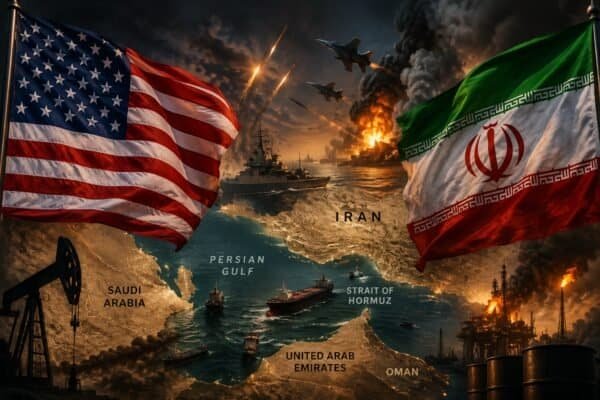
The Market Is Pricing a Policy Collision, Not Just Another Middle East Headline
Geopolitical events often create dramatic headlines but only temporary market effects. Investors have learned to distinguish political rhetoric from a lasting disruption in physical supply. That helps explain why the initial market response was serious but not panicked. Brent crude rose more than 4% and briefly approached $80 per barrel, yet it remained below levels seen earlier in the conflict. The S&P 500 and Nasdaq declined, but the losses were not comparable to a systemic liquidation.
Still, Monday’s cross-asset configuration matters. When war risk rises, investors often expect government bonds and gold to rally as capital seeks protection. This time, Treasury prices fell and yields rose. Gold also declined sharply. The immediate concern was not only physical danger; it was the possibility that higher oil and transportation costs would extend the inflation problem and force central banks to remain restrictive for longer.
At the late-morning Reuters snapshot, the Dow Jones Industrial Average was down 0.28%, the S&P 500 was lower by 0.49% and the Nasdaq Composite had lost 1.06%. The Philadelphia Semiconductor Index was down 3.7%, leaving it more than 14% below its late-June record. Western Digital fell about 6%, Micron roughly 5% and Sandisk around 10%. The technology sector was the weakest group in the S&P 500.
Those moves tell us that the market is not responding uniformly to “war.” It is repricing duration, crowding and financing sensitivity. The areas that had attracted the most enthusiasm—particularly AI infrastructure and memory-chip shares—also contained the greatest amount of valuation risk and investor concentration. A renewed inflation shock raises the discount rate applied to distant future profits. When yields rise, the most expensive part of the market usually feels the pressure first.
The key market question is no longer simply whether oil rises. It is whether higher energy prices remain isolated inside headline inflation or begin spreading into transportation, services, wages, credit conditions and corporate margins. That second-round transmission is what could force the Federal Reserve to act.
What Changed in the Strait of Hormuz
The present escalation follows the breakdown of the fragile interim U.S.–Iran arrangement reached in June. The conflict began on February 28 with U.S. and Israeli military operations against Iran and expanded through attacks on regional military and energy infrastructure. The June memorandum offered markets a possible path toward reopening maritime traffic and reducing the war premium in oil. That optimism had already begun to fade before the latest weekend attacks.
Iran again said it had closed the Strait of Hormuz after renewed military exchanges. President Trump responded by saying the strait would remain open and announcing the return of a U.S. blockade on Iranian shipping. He also said the United States would seek reimbursement equal to 20% of all cargo shipped through the waterway.
That declaration is politically powerful but operationally unresolved. It raises questions about international maritime law, enforcement, insurance, flag states, cargo ownership and whether commercial carriers would accept a U.S.-imposed charge. It should therefore be treated as a policy announcement and escalation signal—not as an already functioning tariff system.
The physical evidence is more useful than the competing claims. Reuters reported that visible oil and gas tanker traffic through the strait fell to its lowest level in two months. Kpler data cited by Reuters showed only six vessels transiting on Sunday, the lowest daily number in five weeks. U.S. Central Command separately said around 20 ships had passed through during the prior 24 hours, but public ship-tracking services continued to show very limited traffic and many vessels were operating with their AIS transponders switched off.
That distinction is critical. A waterway can be “open” in a military or legal sense and still be commercially impaired if tanker owners, insurers and crews decide the risk is unacceptable. Markets care about barrels delivered, freight rates, war-risk premiums and refinery feedstock—not only official statements.
Verified facts versus unresolved claims
- Verified: U.S. and Iranian forces renewed missile and drone attacks; oil prices rose more than 4%; vessel traffic declined materially; U.S. and Iranian authorities issued conflicting statements on control of the strait.
- Reported policy: Trump announced a renewed blockade on Iranian shipping and a proposed 20% charge on cargo.
- Not yet established: A durable legal and operational framework for collecting that charge, normal commercial transit, or a stable diplomatic path capable of ending the conflict.
Why Hormuz Is Bigger Than Iran’s Own Oil Exports
The Strait of Hormuz is one of the world economy’s most important energy chokepoints. Before the present conflict, roughly one-fifth of global daily oil and liquefied natural gas flows moved through the corridor, according to Reuters and historical U.S. Energy Information Administration analysis. The route serves exports from several Gulf producers, not only Iran.
That means the risk is not limited to sanctions on Iranian crude. A prolonged disruption can affect barrels from Saudi Arabia, Iraq, the United Arab Emirates, Kuwait and Qatar-linked LNG supply. Some production can bypass the strait through pipelines, but alternative capacity is limited and cannot immediately replace normal seaborne flows.
The direct market impact begins with crude oil, yet refined products can matter even more to households and companies. The International Energy Agency recently warned that crude supply recovery had outpaced the recovery in refinery operations and refined fuels. Gasoline, diesel and jet fuel can therefore remain tight even if headline crude prices appear manageable.
Europe is particularly exposed to jet-fuel tightness during the summer travel season. Reuters cited Energy Aspects estimates of a potential European jet-fuel deficit near 600,000 barrels per day in the third quarter, with inventories below 30 days of demand cover. That creates a direct transmission channel from Gulf shipping risk to airline operating costs, ticket pricing and consumer travel demand.
Trump’s Economic Contradiction: Lower Rates Meet Higher Oil
President Trump’s economic preferences have usually been clear: strong growth, rising markets, a competitive manufacturing sector and lower financing costs. Those objectives are politically attractive ahead of the November congressional elections. But the administration’s Iran strategy is now generating an opposing force.
A military escalation around Hormuz can lift oil, gasoline, diesel, aviation fuel, marine insurance and freight costs. Those increases reach households quickly and are highly visible. Voters see gasoline prices every day. Businesses feel transportation and logistics costs before many other forms of inflation. If those costs persist, companies attempt to protect margins by raising prices, limiting hiring, delaying investment or reducing other expenses.
That leaves the White House with an uncomfortable policy triangle:
- maintain military and economic pressure on Iran;
- keep energy and consumer prices under control;
- encourage lower interest rates and easier financial conditions.
It may be possible to achieve two of those objectives temporarily, but achieving all three at once becomes progressively harder as the conflict continues. The United States can escort vessels, release strategic reserves, encourage domestic production and pressure allies to increase supply. None of those tools guarantees a rapid decline in refined-product prices if shipping remains impaired and regional infrastructure stays vulnerable.
The proposed 20% cargo charge also creates an additional contradiction. If enforced, it could raise the delivered cost of energy and other goods even while the administration argues that the policy is necessary to protect freedom of navigation. From a market perspective, the relevant question is not who is legally or politically entitled to control the route. It is who ultimately pays the incremental cost. In most supply chains, some portion eventually reaches consumers.
The Strategic Petroleum Reserve is a smaller cushion
U.S. Strategic Petroleum Reserve inventories fell to about 316.5 million barrels in the week ended July 10, the lowest level since April 1983, according to Department of Energy data reported by Reuters. The reserve has declined by almost 99 million barrels since the war began. The United States still possesses emergency capacity, but every release reduces the future buffer and makes the market more sensitive to how long the disruption lasts.
The Federal Reserve Is Now at the Center of the War Trade
The Federal Reserve held the federal-funds target range at 3.50%–3.75% in June. New Chair Kevin Warsh has emphasized that the central bank intends to return inflation to its 2% objective and has resisted providing the kind of detailed forward guidance markets became accustomed to under previous leadership.
That communication style places more weight on each incoming data release. Tuesday’s June Consumer Price Index was already important. It has become more consequential because it arrives immediately after oil’s renewed surge and alongside Warsh’s first monetary-policy testimony before Congress.
Governor Christopher Waller sharpened the debate on Monday. He said the Fed may need to raise rates in the near term if new data show inflation remaining well above target or moving higher. He described policy as being at a crossroads and warned against becoming complacent if price pressures continue to broaden.
The phrase “broaden” is the key. Central banks often look through a temporary energy shock because raising rates cannot produce more oil or reopen a shipping lane. But they cannot ignore the shock if businesses and households begin to expect persistently higher inflation or if higher energy costs spread through services, rents, wages and core goods.
Markets have moved toward the more hawkish interpretation. LSEG data cited by Reuters indicated that futures were pricing about 30 basis points of additional tightening in 2026, while other Reuters reporting put the probability of a September increase near 70%. At least one quarter-point hike is therefore meaningfully reflected in market pricing.
Economists remain less convinced. A late-June Reuters poll found that more than three-quarters expected the Fed to hold rates unchanged through the rest of 2026. That disagreement between economists and traders creates a volatile setup. If CPI is hot and Warsh sounds uncompromising, the market can rapidly price a higher terminal rate. If core inflation cools and Warsh separates the oil shock from persistent inflation, rate expectations may retreat.
| Transmission channel | First variable affected | Corporate impact | Equity-market implication |
|---|---|---|---|
| Hormuz disruption | Crude, LNG, freight and insurance | Higher input and delivery costs | Energy resilience; pressure on airlines, transport, chemicals and discretionary demand |
| Oil-driven inflation | CPI, inflation expectations | Margin pressure and weaker real purchasing power | Multiple compression in long-duration growth and rate-sensitive equities |
| More hawkish Fed | 2-year and 10-year Treasury yields | Higher debt refinancing and capital costs | Pressure on small caps, REITs, utilities and cash-burning biotech |
| Stronger dollar | FX translation and commodity purchasing power | Mixed effect by revenue and cost geography | Headwind for multinational earnings; added stress for oil-importing economies |
| Risk-off positioning | Volatility and crowded trades | Little immediate fundamental change | Fast selling in semiconductors, AI proxies and other high-momentum groups |
Why Bond Yields Rose Instead of Falling
The 10-year Treasury yield climbed to approximately 4.598%, the 30-year yield rose above 5.09% and the two-year yield reached about 4.248% at the Reuters market snapshot. The two-year maturity is particularly important because it is closely connected to expectations for Federal Reserve policy.
If investors believed the conflict would primarily destroy demand and cause a recession, they might buy Treasuries and push yields lower. Monday’s move suggested a different first reaction: the market viewed the escalation primarily as an inflation threat.
That does not mean recession risk has disappeared. An extended oil shock can eventually produce both weaker growth and higher inflation—a stagflationary combination. But the sequencing matters. The first move is higher energy prices. The second is concern that the Fed will keep policy tight. Only later, if consumer spending and corporate activity deteriorate, might recession fears dominate and push yields lower.
This sequencing is why equity investors should avoid simplistic assumptions. “War means bonds rise” and “oil up means energy stocks up” are incomplete statements. The duration, location and physical consequences of the conflict determine the result.
Gold’s Decline Is a Warning About the Nature of the Shock
Gold fell nearly 3% on Monday even as the conflict escalated. That may look counterintuitive, but it reinforces the same message coming from Treasuries. Gold produces no income. When real and nominal yields rise and markets anticipate tighter monetary policy, the opportunity cost of holding gold increases.
The metal can still perform well if the conflict broadens, confidence in government institutions deteriorates or currencies weaken. Monday’s decline simply shows that investors were treating the immediate event as an inflation-and-rates shock rather than a pure collapse in confidence.
That is an important distinction for market positioning. A portfolio cannot be hedged effectively by assuming that every traditional safe haven will respond in the same way to every geopolitical event.
Semiconductors: Strong Demand Does Not Eliminate Valuation Risk
Memory-chip and AI-related stocks suffered some of Monday’s largest losses. South Korea’s KOSPI fell almost 9%, re-entering bear-market territory, while SK Hynix declined more than 15% in Seoul and roughly 9% in U.S. trading. The selloff followed a strong Nasdaq debut and a major rally earlier in the year.
Nothing in the Hormuz story directly reduces demand for high-bandwidth memory or data-center computing. The transmission mechanism is financial rather than operational: higher oil raises inflation risk, inflation risk raises yields, and higher yields reduce the present value of long-dated growth expectations. Crowded trades then experience faster selling as investors reduce exposure and volatility-control strategies react.
This does not prove that the AI investment cycle is ending. It does show that excellent demand cannot protect a stock indefinitely from valuation, positioning and liquidity risk. TSMC and ASML earnings will provide an early test of whether the fundamental AI spending narrative remains strong enough to counter the macro pressure.
Sector proxies such as $SMH and $SOXX are useful indicators of whether the selloff remains concentrated in high-momentum memory names or broadens into equipment, foundries, networking and analog semiconductors.
Energy: The Most Direct Beneficiary, But Not a One-Way Trade
Energy equities gained as crude prices rose. The logic is straightforward for producers with unhedged output and manageable costs: higher realized prices can improve revenue, cash generation and capital returns. Integrated majors may also benefit from trading operations and geographic diversification.
Yet even energy is not a uniform winner. Refiners can face volatile crude differentials, disrupted feedstock access and unpredictable product cracks. Oilfield-service companies benefit only if higher prices lead producers to raise spending, which usually takes time. Gulf-exposed infrastructure and shipping assets may face direct physical and insurance risks. Companies with aggressive hedging may realize less upside than spot prices imply.
The most useful market proxies include $XLE for integrated energy, $XOP for exploration and production and $OIH for oilfield services. These are monitoring tools, not interchangeable expressions. Their earnings mechanisms differ materially.
The strongest counterargument to a sustained energy rally is that global demand has weakened and supply can recover quickly if diplomacy resumes. OPEC reduced its 2026 demand-growth forecast again on Monday. The International Energy Agency has also described a market in which substantial supply can return if Hormuz traffic normalizes. That potential supply response helps explain why Brent remains around $80 rather than trading at crisis extremes.
Airlines, Travel and Transport: Where the Oil Shock Reaches Earnings Quickly
European travel and leisure shares declined on Monday, with Lufthansa, Ryanair and TUI among the names under pressure. Airlines have one of the clearest exposure paths: jet fuel is a major operating expense, and the ability to pass higher costs to passengers depends on demand, competition, hedging and booking lead times.
An airline with favorable fuel hedges may be protected initially but still face higher future costs when those hedges expire. A carrier with strong pricing power can raise fares, but higher ticket prices may eventually reduce discretionary travel. Airports, hotels and online travel platforms can therefore experience second-order effects even when their direct fuel exposure is limited.
The same logic applies to trucking, parcel delivery, shipping and logistics. Fuel surcharges can protect revenue, but they also raise the delivered cost of goods and may reduce shipment volumes. The $JETS ETF offers a broad view of airline-market sentiment, while individual carriers require separate analysis of hedging, routes, balance sheets and pricing power.
Healthcare and Biotech: Defensive Rotation Has Limits
Healthcare can attract capital during macro uncertainty because demand for many medicines and medical services is less cyclical than demand for discretionary goods. Large pharmaceutical companies with established cash flow, visible pipelines and strong balance sheets may therefore offer relative stability when technology multiples compress.
But “healthcare is defensive” is not a complete biotech thesis. Pre-revenue biotechnology companies are long-duration assets. Their valuations depend on future clinical and commercial cash flows, and many require repeated access to capital markets. Rising Treasury yields increase discount rates and make equity financing more expensive. That can offset any defensive sector rotation.
The result is likely to be greater differentiation:
- commercial-stage companies with cash flow and limited refinancing needs may hold up better;
- companies approaching major FDA or clinical catalysts may trade on idiosyncratic data rather than macro direction;
- cash-burning small caps with short runways, active ATM programs or near-term financing needs remain vulnerable to higher yields and weaker risk appetite;
- large-cap pharmaceuticals may receive a relative bid without the entire $XBI complex participating.
For Merlintrader readers, this is the practical lesson: a macro risk-off day does not invalidate a clinical catalyst, but it can change the financing environment, the market’s tolerance for uncertainty and the multiple assigned to a successful outcome.
Small Caps: The Hidden Cost Is the Price of Capital
Small-cap companies often have less pricing power, more concentrated revenue, weaker balance sheets and greater dependence on external financing. An oil shock can therefore hurt them through several channels at once: higher transportation costs, weaker consumer demand, higher interest expense and reduced investor appetite for speculative securities.
The Russell 2000 and $IWM deserve close attention even if the large-cap indexes remain near records. A market can appear resilient at the S&P 500 level while financing conditions deteriorate underneath the surface. The companies most exposed are not necessarily those with the largest direct energy bills. They are often the companies that need to refinance debt, issue equity or fund several years of negative free cash flow.
This is especially relevant to space, defense technology, emerging AI infrastructure and development-stage healthcare. A geopolitical narrative can support attention and contract expectations, but higher discount rates still matter. Companies with verified backlog, funded contracts and adequate liquidity should separate from companies whose valuations depend mainly on distant possibilities.
Defense Stocks Are Not an Automatic War Hedge
European defense shares fell about 1.4% on Monday even as the conflict intensified. That is a useful reminder that defense equities do not rise mechanically with every military escalation. Performance depends on valuation, positioning, contract awards, procurement budgets, production capacity and whether the event changes long-term spending plans.
A drone attack may increase demand for air defense, counter-UAS systems, interceptors, sensors and electronic warfare. But a company benefits financially only if urgency becomes funded procurement, production ramps successfully and margins are preserved. Investors should distinguish the political headline from the revenue pathway.
That same filter should be applied to space and autonomous-systems companies. A credible read-through requires evidence linking the conflict to orders, backlog, deployment or budget allocation—not simply a thematic association with defense.
Banks and Financials: Higher Yields Help Until Credit Risk Takes Over
Major U.S. banks begin reporting second-quarter earnings this week. A higher-rate environment can support net interest income, but the benefit depends on deposit costs, loan growth, the shape of the yield curve and credit quality.
An oil shock creates a mixed setup. Energy producers may improve financially, while airlines, transportation companies and lower-income consumers can weaken. Market volatility can support trading revenue, yet falling asset prices may slow underwriting and deal activity. Banks with strong capital and diversified revenue may navigate the environment better than lenders concentrated in rate-sensitive commercial real estate or vulnerable consumer credit.
Bank earnings will therefore provide more than a retrospective view of the second quarter. Management commentary on credit, deposits, consumer spending and corporate confidence will help determine whether the war is still a market shock or is beginning to affect the real economy.
What Is Already Priced In—and What Is Not
Partly priced
- A renewed geopolitical premium in oil.
- At least one possible Federal Reserve rate increase in 2026.
- Greater volatility and multiple pressure in crowded semiconductor trades.
- Near-term relative strength in energy and pressure on airlines and transport.
Still requires proof
- Whether Hormuz traffic remains materially impaired for weeks rather than days.
- Whether the proposed U.S. cargo charge is legally and commercially implemented.
- Whether higher energy costs spread into core inflation and wages.
- Whether the Fed actually raises rates or keeps policy unchanged while waiting for the shock to fade.
- Whether the semiconductor pullback becomes a broader break in the AI capital-spending narrative.
- Whether consumer spending and corporate credit deteriorate enough to create recession risk.
Merlintrader Scenario Framework
The following probabilities are an editorial scenario framework, not a forecast or investment recommendation. They are intended to organize the variables that would confirm or invalidate each path.
50%Base case
Contained escalation and partial normalization
Military exchanges continue intermittently, but commercial traffic gradually improves under escort or through a renewed temporary arrangement. Brent remains broadly in a $75–$85 range. Inflation stays uncomfortable but does not accelerate enough to force an immediate Fed move. Energy retains relative strength, while technology stabilizes after valuation adjustment.
Confirmation: rising vessel transits, falling insurance premiums, no major infrastructure damage, softer core CPI and restrained Warsh testimony.
35%Inflation case
Prolonged partial disruption and renewed tightening
Hormuz remains commercially impaired, refined products stay tight and Brent moves into an $85–$100 zone. Core inflation proves sticky, the Fed raises rates by 25–50 basis points over the remainder of 2026 and Treasury yields remain elevated. Energy and selected defense exposures outperform relatively; airlines, consumer discretionary, small caps and long-duration growth face sustained pressure.
Confirmation: persistently low tanker traffic, rising freight and gasoline prices, hot CPI/PPI data, hawkish Fed language and widening credit spreads.
15%Tail risk
Severe closure, infrastructure damage and stagflation shock
A major attack damages regional energy infrastructure or shipping becomes broadly unavailable. Brent moves above $100, refined-product prices rise faster and emergency reserves are drawn more aggressively. Inflation and growth deteriorate simultaneously. Equity losses broaden beyond technology, credit conditions tighten and the Fed faces the classic stagflation dilemma of choosing between price stability and economic support.
Confirmation: sustained physical closure, verified damage to export terminals or refineries, rapid inventory declines, emergency international coordination and a sharp deterioration in consumer or business activity.
The Strongest Counterargument: Markets Have Seen This Movie Before
The most credible bullish counterargument is that markets have repeatedly overestimated the duration of Middle East escalations. Trump’s negotiating strategy often combines maximalist public pressure with a willingness to pivot quickly toward a deal. Iran also has a strong economic incentive to keep some trade flowing. Global oil demand has softened, alternative routes exist and producers outside the Gulf can respond over time.
Under that interpretation, Monday’s oil spike represents a temporary risk premium rather than the beginning of a new inflation regime. The S&P 500’s limited decline supports the argument that investors are not pricing a catastrophic outcome. If tanker traffic recovers and CPI cools, the bond-market selloff could reverse quickly, allowing technology and other growth sectors to rebound.
That counterargument should not be dismissed. It is one reason the base case above remains a contained escalation rather than a severe closure. But it also depends on physical normalization, not rhetoric. The market can ignore political noise only while barrels continue moving.
What Investors Should Monitor Over the Next 72 Hours
| Signal | Why it matters | Constructive reading | Risk reading |
|---|---|---|---|
| Hormuz vessel traffic | Best direct measure of commercial normalization | Daily transits recover consistently | Traffic remains minimal despite official assurances |
| Brent crude and refined products | Measures the inflation impulse | Brent holds below $85 and gasoline eases | Brent approaches $100; product cracks widen |
| June CPI and core CPI | Determines whether inflation is broadening | Core inflation cools | Another hot core reading |
| Warsh testimony | Sets the Fed reaction function | Emphasis on patience and temporary energy effects | Explicit willingness to tighten soon |
| 2-year and 10-year Treasury yields | Transmit macro risk into equity valuations | Yields retreat from current levels | 10-year sustains above 4.6%; 30-year above 5.1% |
| Semiconductor breadth | Tests whether the move is crowding or fundamental | Weakness stays concentrated in memory | Selloff spreads through equipment and foundries |
| Bank and corporate commentary | Shows whether the shock is reaching the real economy | Stable credit and spending | Rising delinquencies, weaker demand, delayed investment |
| SPR and commercial inventories | Measures the remaining policy cushion | Draws slow and domestic stocks stabilize | Accelerating emergency releases and falling inventories |
Bottom Line
The market has not yet priced a full closure of the Strait of Hormuz or a global energy crisis. If it had, oil would be much higher, equity losses broader and volatility more extreme. What the market has begun to price is a renewed collision between geopolitics and monetary policy.
Trump’s escalation strategy may strengthen U.S. leverage against Iran, but it also raises the cost of energy, weakens the argument for lower interest rates and increases the political burden of inflation. The Federal Reserve cannot reopen Hormuz, but it may still tighten policy if the resulting price increases spread through the economy. That is why Treasury yields rose, gold fell and highly valued semiconductor shares suffered.
For equity investors, the correct response is not to reduce the entire market to a simple list of “war winners” and “war losers.” The more useful framework is to follow the transmission chain:
Hormuz disruption → energy and freight costs → inflation expectations → Federal Reserve policy → Treasury yields → corporate financing and equity valuations.
Energy is the clearest direct beneficiary, but even there the effect depends on production, hedging, infrastructure and demand. Airlines and transport face immediate cost pressure. Technology and small caps are exposed through yields and positioning. Healthcare may provide relative defense, but cash-burning biotech remains sensitive to the price of capital. Defense and space stocks need funded orders, not merely dramatic headlines.
The next decisive information will come from three places: actual ship movements through Hormuz, Tuesday’s inflation data and Kevin Warsh’s testimony. Until those signals arrive, the market is likely to remain volatile, headline-driven and highly selective.
Primary and High-Quality Sources
- Reuters — Trump says U.S. reinstates blockade of Iranian shipping after renewed clashes
- Reuters — Hormuz tanker traffic falls to a two-month low as safety risks rise
- Reuters — Wall Street slips as Iran tensions hit sentiment and chipmakers fall
- Reuters — Stocks slip, oil rallies and bond yields rise as Gulf conflict escalates
- Reuters — Oil gains more than 4% after renewed U.S.–Iran escalation
- Reuters — Fed Governor Waller says higher rates may be needed in the near term
- Reuters — U.S. Strategic Petroleum Reserve falls to its lowest level since 1983
- Reuters — Gold falls as oil shock increases expectations for tighter policy
- Reuters — Wall Street week ahead: earnings, CPI and Iran headlines
- Reuters poll — Economists and market pricing diverge on the 2026 Fed path
- U.S. Energy Information Administration — World Oil Transit Chokepoints